Sunday, 12 December 2021

David Fincher Filmography

The heir to Stanley Kubrick from a directing perspective, David Fincher is best known for his crime and thriller films that have dark and moody atmospheres and the occasional narrative twist. Notorious for his extensive amount of takes and 'control freak' persona, Fincher's film always come across as polished, slickly edited productions dotted with electrifying performances. Let's take a look at his work. 

11. Alien^3 

It is contentious as to whether the third instalment of the Alien franchise should make the list; despite being Fincher's debut it was a butchered, studio-twisted film that the director himself wants nothing to do with. It is Fincher's only truly bad film: the infuriating handling of some of the characters from Aliens at the start sets off a narrative that feels unfulfilling and second-rate compared to the predecessors. Fincher still crafts a film that impresses visually, with a handful of famous shots, but this is one best to forget exists. 

10. The Game 

It is testament to Fincher's quality of output that The Game is his second weakest film. Michael Douglas plays a millionaire who finds himself playing a 'game' that forces him to question what is real, what is dangerous and what isn't. It is a firmly 1990s film, and Douglas is solid in the lead: he doesn't 'lose it' too early so as to stagnate the rest of the film but there is still a seething sense of frustration coming from his performance that really works. Let down by a twist that forces you to forget a lot of what came before, The Game is adequate as a slow burner, but not overly memorable. 

9. The Curious Case of Benjamin Button 

Fincher's only fantasy-romance film, Benjamin Button is ferociously long for a short story adaptation, but the concept of a man who lives his life backards is utilised well. Anchored by a stoic Brad Pitt performance and some helpful visual effects work, Fincher smoothly resurrects the early 20th century with immaculate costumes and sets. Ultimately the picture doesn't have too much to actually say beyond 'old people and babies have similarities' but there is a literary feel to the film that makes for pleasent Sunday afternoon viewing. 

8. Mank 

Fincher's most personal film is his most recent. Adapting his late father's screenplay, the picture charts   Gary Oldman as Herman Mankiewicz, the screenwriter of the legendary Citizen Kane, who tussels for creative control in the Golden Era of Hollywood. For lovers of Kane, Orson Welles, classic films and the era as a whole, this is a gem to behold. Packed with authentic detail, gorgeous monochrome photography and a unique, highly designed sound scape, it is a cornucopia of film Easter eggs. But whilst it is technically impressive, the story and purpose of the film are sketchy. Much like Tarantino's Once Upon a Time in Hollywood, Mank serves as a visual autobiography for its director who struggles to get his vision in modern Hollywood. Fincher must see something of himself in the screenplay, because there is little else to thematically and emotionally attatch to here. 

7. Zodiac 

This may seem like heresy to some to have Zodiac slap-bang in the middle of a Fincher ranking, and it's understandable why this is a highly appreciated film. Drawing on three engaging performances from Robert Downey Jr., Jake Gyllenhaal and Mark Ruffalo, Fincher's childhood obsession with the Zodiac killings is painstakingly animated into celluloid. The killings are exceptionally directed and the screenplay is chock full of details and theories that demand further research. The basement scene is also outstanding too. Where the film suffers is its length. This is the longest 160 minute film going: if you don't look at the time then it can become impatient as it mercilessly continues to include seemingly every important date and detail in the case. It is documentary-esque in approach and perhaps that is the alternative for this story so as to condense the bum-numbing run time.

6. Panic Room 

A moderately underrated thriller. Fincher goes full Hitchcock for this one, following a stylish opening credit scene he sets the cameras up in a rather nice, empty new home in the city and never leaves it for two hours. Jodie Foster and Kristen Stewart are the mother and daughter who have just moved in and find themselves under siege in the house's panic room when Jared Leto and Forest Whitaker break in for some illegal antics. If the set-up feels too basic for a 120 minute picture, then marvel at how Fincher and cinematographers Conrad Hall and Darius Khondji find new and inventive ways to smoothly move the camera around to create a very dynamic experience within the confines of the claustrophobic setting. The payoff does have its ex machina moments, but as a thriller that thrills effectively, it accomplishes exactly what it intends. 

5. The Girl with the Dragon Tattoo 

A worthy English-language remake, this Daniel Craig-starrer has all the murkiness of Denis Villenueve's Prisoners. Boasting astounding work from Daniel Craig, Rooney Mara and Stellan Skarsgaard, Dragon Tattoo is crisply shot and filled with some horrific, unforgettable images. Often unflinching, Fincher directs with utter calmness whilst the Oscar-winning editing is truly flawless. Having made this so swiftly after The Social Network is a feat unto itself.  


4. The Social Network

A critic's favourite film, this is frequently cited as one of the greatest films of the 2010s. It's easy to see why: Fincher is fully in control of the subject matter as he chronicles the emergence of Facebook and the appalling behaviour of the insufferable Mark Zuckerberg. Aaron Sorkin's high energy script absorbs from the first scene, and the irritating Jesse Eisenberg is annoyingly good casting as the equally irritating tech giant. The score is mesmerising and Andrew Garfield knocks it out of the park too. But please Fincher, what did you do with the other Armie Hammer twin?


3. Gone Girl 

A total surprise of a film considering how popular the novel was among mums (think Fifty Shades of Grey and Girl on the Train). Fincher is at home making elusive crime films and Gone Girl summons a shedload of the director's creative juices. Captivating through Rosamund Pike's tour de force performance, the mysteries and relationships are intoxicating dramatically. When it is violent it is very violent, but it earns the right to be due to the slow pacing and unease. 


2. Fight Club 

It's easy to hate on Fight Club: like Joker, American Psycho and The Wolf of Wall Street. it belongs firmly in the film-bro camp of idolised cinematic texts. Fight Club is one of two Fincher films I have seen twice and if the first time underwhelmed, the second time was a blast. The brutal fight scenes, charismatic Brad Pitt performance and its position on consumerism are fascinating, whilst the tackling of masclinity is divisive and incomplete. If it suffers from all of its narration, it makes up for it with wry humour and a total ridiculousness that makes it a terrifically enjoyable ride. 


1. Se7en 

David Fincher's best film, Se7en is one of the greatest films of the 1990s. Brad Pitt and Morgan Freeman investigating murders inspired by the Seven Deadly Sins is a tantalising prospect on its own, but the rain lashed city, unnerving third-act and haunting final lines seal this in the memory. The devil is in the details and Fincher packs the film with them: the opening credits, the macabre images and the heavy foreshadowing are joyful to unpack on second viewing. By the time the three main characters get in a car together to an undisclosed location, it's hard to blink. 


Sunday, 4 April 2021

Godzilla vs Kong Review

 Big fights between big names always do gangbuster business. Whether its Mayweather vs Pacquiao or Batman vs Superman, brand names smashing the living daylights out of each other has an immense failure. Enter Godzilla vs Kong, the fourth entry in Warner Bros’ ‘Monsterverse’ franchise that sees an amphibious nuclear dinosaur fight a big monkey. The film’s title does an excellent job at explaining the content to be honest.

The road to Godzilla vs Kong has been an odd one. It started with 2014’s Godzilla, a mature, Nolanised take on the Japanese icon that largely deprived audiences of its eponymous character. In 2017 came the exceedingly fun B-movie Kong: Skull Island which brought Hollywood’s legendary ape into the same universe, and at a far greater size than ever seen before. 2019’s Godzilla: King of the Monsters was a critical and commercial failure despite its notable attempts at listening to its predecessor’s flaws. Luckily, Godzilla vs Kong was already in production, so the financial shortcomings did not affect this. And what luck that was, because this is the most preposterously enjoyable blockbuster since Mission Impossible: Fallout.

People don’t go to independent films for their innovative CGI, and nor should people go into a film literally called ‘Godzilla vs Kong’ expecting a tightly woven script peppered with three-dimensional characters. The characters are as minimal as possible to make room for the earth-shaking monster brawls, but in the words of Obi-wan Kenobi “… that’s… why I’m here.”

The plot, as irrelevant as it is, concerns the journey undertaken by Kong and his human allies to the centre of the earth in order to combat Godzilla, who has begun attacking the labs of definitely-not-crooked company Apex Cybernetics. On Team Kong there’s Alexander Skarsgard, Rebecca Hall and Kaylee Hottle as Jia, a deaf child whose unique relationship with Kong is the emotional crux of the film as both are the last native inhabitants of Skull Island. Trying to uncover the purpose of Godzilla’s rogue antics is a returning Millie Bobbie Brown and two comic-relief sidekicks played by Julian Dennison and Brian Tyree Henry. The human scenes are ultimately equivalent to the adverts before during and after a televised sporting match: you endure them patiently because the good stuff is just around the corner. Of course, I have seen people hate on the picture by comparing it to such films as Jurassic Park where we actually like and bond with the human characters as well as having big dinosaur action. To this I counter that, with Jurassic Park, the film has a build-up before introducing the dinosaurs which heightens the drama as this is the first film in a franchise (Godzilla too was all build-up). Secondly, Godzilla vs Kong has already established its two icons in previous films so they can be introduced from the get go and the fighting is between those two as opposed to dinosaurs vs humans. This means Godzilla vs Kong gets away with not needing 3D characters because they are not a part of the main conflict. 

There have been many ‘vs’ films across the decades: Aliens vs Predator, Freddy vs Jason, Kramer vs Kramer (well, maybe not that one) but the problem most of these films have is that they never fully embrace their title, and instead flirt around the edges of the concept or get bogged down with other story strands. Director Adam Wingard (the fourth low-budget indie director to be handed the reins for an enormous blockbuster within the franchise) commits entirely to the titular premise. The sparkling marketing campaign and the ludicrous premise have been spoofed and memed in the build-up to it, and its nice to see the film enjoy itself as much as the trailers do (take notes The Meg). It’s barely forty minutes in before the two juddering juggernauts are smacking each other senseless, and then the final forty minutes ramps things up even more. The film knows what it is, and what it needs to be, emphasised by the bookending of the film with two brilliant song choices. 

Wingard (You’re Next, The Guest) directs the mayhem with absolute clarity. Unlucky King of the Monsters, this is gloriously radiant in its colours and maintains the staggering wide shots for as long as possible. One sequence in a neon-drenched Hong Kong sees the titans go at it for what might be the lengthiest monster fight without cutting to a human. It is the blockbuster filmmaking fans of the franchise have been clamouring for: less people, more beautiful destruction (which is scored by another bombastic effort from Warner Bros’ regular Junkie XL). Aside from the scraps, the film’s second act unveils the mythical ‘Hollow Earth’ which really is cinema-worthy material. The gravity bending landscapes and enormous scale is as breath-taking as one would hope after three films of mentioning it, to the point that it could be called ‘Money Shot: The Movie’.  

Godzilla vs Kong has already become a massive success in a post-Covid film industry, showing that where Christopher Nolan and Wonder Woman failed, it took two of cinema’s oldest icons turning buildings to butter to get the industry going again. Despite being between Godzilla and King Kong, the real winner is cinema. Who would have thought it?

Legendary Entertainment 


Tuesday, 9 March 2021

Mann-erisms: Ranking the 11 Films of Michael Mann

 Michael Mann is a filmmaker whose career is fascinating to investigate. Unleashing his theatrical debut, Thief, in 1981, Mann has since made ten more films over a 39 year career. He likes taking several years off between his pictures, no doubt due to his intense research and preparation for his projects. An auteur if you are aware of his style, Mann's films are defined by their authentic detail and feel, the sleek visual style, innovative camera choices and handling of such themes as masculinity, honour and codes and crime. .His films are not always commercial successes, and only one of his films has won an Academy Award (The Last of the Mohicans won for Sound). But among his ouvre are some immensely influential films. Without Mann we might not have got CSI: Crime Scene Investigation, The Dark Knight, John Wick and digital photography. 

I first became aware of Mann as a director following my first watch of The Last of the Mohicans. Heat was next but it took several years before I started hunting down his other films. Finally, having accessed all 11 of his features, I can rank them. 

11. The Keep (1983)

A film about Nazis stuck in a castle with an antagonistic supernatural presence should write itself. Butchered by the studio, Mann's sophomore effort is rumoured to have a 210 minute cut. As it stands, it clocks in at under 100 minutes and is all the worse for it. In desperate need of remastering, this is a dismally edited audio mess with a bizarre Tangerine Dream score that plays far too loudly. Mann's direction is assured, and there are inspired shots, but the intense tone cannot match the goofy effects, careless ending and lack of irony. Not even Ian McKellen can work magic with this unfortunate mess. 

10. Miami Vice (2006)

Having never watched the TV show, I went into this completely blind. Miami Vice is a mess of a film, allegedly hampered by an arrogant Jamie Foxx's refusal to do certain sequences, which led to numerous re-writes. Foxx is joined by Colin Farrell and neither of their characters make an impact. The story is dense and often impenetrable, whilst the action and shootouts feel insignificant compared to what Mann has done before and after. A dull, humourless watch.  

9. Blackhat (2015) 

Taken out of context, Blackhat has a slew of very good scenes. A diner brawl, a tunnel shootout with immersive sound design and a visually stunning finale are all YouTube worthy to revisit. But in the context of the narrative, it breaks the suspension of belief. The casting of Chris Hemsworth as an American computer hacker still baffles: this techno-nerd is also a bodybuilding tank capable of dispatching enemies with tables and screwdrivers alike. It often feels silly. Blackhat succeeds as a thriller that makes the dangers of cyber-crime very clear, and feels like the natural evolution of Mann's fascination with criminals. There are some intense and unexpected moments, but an uneven runtime and poor casting make this close to being a good film.  

8. Public Enemies (2009)

Public Enemies should have been a walk in the park for Mann to make: a period set historical film about a wanted bank robber and the FBI agent trying to bring him down, with two of the most popular actors of their generation at the peak of their powers playing the two leads. It was meant to be Heat but set in the 1930s. After watching it, the film feels like a poor substitute. There is a lot of greatness in this film, but an equal amount of frustration and missed potential. Johnny Depp is singularly brilliant as John Dillinger, whilst Christian Bale is criminally underused and uninteresting as Melvin Purvis. The cinematography is terrific but the usage of high definition digital camera makes it look more televised than cinematic. The shootouts are good but there is a sense of pulling punches in them. Public Enemies only really works when Depp is on-screen, and despite the struggle in getting there, the finale is magnificently helmed and scored. Agonisingly close to being a thumbs up.

7. Manhunter (1986)

Before Mads Mikkelson and Anthony Hopkins, Brian Cox was Hannibal Lecter. Based on the book Red Dragon, the film follows William Peterson as Will Graham as he investigates the killings of the 'Tooth Fairy' with the help of former nemesis Lecter. Manhunter is definitely a Michael Mann film: an unusual musical score which overplays its hand here and there, strikingly vivid visuals and colour representations, and forensic detail. A methodically paced picture, it makes for unsettling viewing. 

6. Ali (2001)

A lot of Mann's films cast actors at their peak popularity. Such is the casting of Will Smith as Muhammad Ali. Following his charismatic performances in Independence Day and Men in Black among others, Smith's role as Ali secured him an Oscar nomination and proved he was a certified dramatic actor. Despite a 145 minute runtime, Ali is entertaining filmmaking thanks to some tasteful cinematography (Emmanuel Lubezki!) and the expected authentic direction. Tracing Ali's life through the 1960s and culminating with the legendary Rumble in the Jungle, the film finds time to be a sports picture, a biopic, a civil rights film, an anti-war film and a fascinating look at America in the two decades. With a comforting cast including Jamie Foxx, Giancarlo Esposito, Jeffrey Wright and an invisible Jon Voight, Mann's film just about does justice to an incredible person's turbulent life. The first boxing match and the assassination of Malcolm X are knockout scenes. 

5. Thief (1981)

Mann's first feature is a startling debut. A stripped down version of Heat, this tightly contained picture stars James Caan as the eponymous jewel thief who wants to start a family life away from crime. Inevitably he's sucked in further, leading to a fiery finale. Thief announces Mann's style quitely: the authenticity and detail in the heists, the neon visuals and smooth shot composure, the cold tone, the excellent sound design. It takes a while to properly get into the story, but once the direction starts feeling more confident (and the Tangerine Dream score becomes addictive) then Thief is helluva underrated 1980s crime picture. 

4. Collateral (2004)

Casting actors against type is often fun, with Henry Fonda in Once Upon a Time in the West being a personal favourite. In close second is Tom Cruise in Collateral. Sporting a grey suit and grey hair, Cruise's Vincent is one of the superstar's greatest roles. The story is contained and simple: Jamie Foxx plays Max, a cab driver, who unknowingly (and then is forced to) drives Vincent around night-time LA so the latter, a hitman, can execute people on his list. Their dynamic is an entertaining one, and Mann's acute visual exploration of a city at night is terrific stuff. A muscular film in its editing and sound effects, Collateral is evidence that Mann is relishing making the film: the night club sequence pre-empts John Wick, the cat and mouse finale is riveting and the "Yo homie, is that my briefcase?" never gets old. The two men, both methodical workers who enjoy what they do, find similarities despite the wildly different moral codes. There is a superb bit of subtext where Vincent saves Max too, a wordless exchange which amounts to something like respect. The climax is doubtful, but this is a fun thriller. 

3. The Insider (1999) 

A whistle-blower docu-drama might not be the most accessible film (especially with a massive runtime), but under Mann's acute eye The Insider is his most critically praised film. Securing numerous Oscar nominations, it stars Russell Crowe (hitting the prime of his career) and Al Pacino as Jeffrey Wigand, a whistle blower for tobacco companies, and the television producer wanting to tell his story respectively. Both are frightfully good. Confidently made, with numerous director's tricks at hand, The Insider is informative and gripping. 

2. The Last of the Mohicans (1992)

The Last of the Mohicans is a unique film. Unique in its position among Mann's modern and crime set filmography, and unique as a historical film. It has few, if any, contemporaries, much like Master and Commander's hegemony over the Napoleonic War era. Set in 18th century America, the brisk epic sees Daniel Day-Lewis play Hawkeye, a white man raised by the last of the Mohican tribe. With his adoptive brother and father, they end up escorting and protecting an English captain and the two daughters of an English general. Hot on their tails is Wes Studi's Magua, a terrific enemy. Mann and Day-Lewis spent time in the wilderness hunting and trapping in preparation for the shoot, and the result is an authentic experience that features stunning on-location landscapes and a truly tremendous score. The action is exciting yet brutal, and the drama feels at first rushed, but on second and third viewing the strength of the subtext makes all of the dramatic moments land, and them some. The final sequence, rightfully revered, is one of the great movie moments. 

1. Heat (1995)

Unanimously agreed on as being Mann's most essential film, Heat is an all-timer. A 170 minute crime epic, the picture turns LA into a dense, populated labyrinth filled with characters each with their own story. A superb cat and mouse thriller, Mann brought Al Pacino and Robert De Niro together onscreen to electrifying effect as the detective tracking down a professional thief. The bursts of action are muscular, not the least centrepiece shootout which requires the highest volume permitted. Alongside the two acting heavyweights, Mann peoples the script with Jon Voight, Wes Studi, Natalie Portman and a scene stealing Val Kilmer too. The result is a fascinating character study of clashing yet similar philosophies, with Pacino and De Niro being mirror opposites of each other. Their diner scene is a stunning display of acting whilst their final confrontation is somewhat moving. The greatest film of the 1990s. 

Saturday, 19 December 2020

2020 in Review

 Glazing over the fact that 2020 has disrupted the world, it is devastating that the business decisions by studios, especially towards streaming services, will have rippling effects for years to come. In a year that was meant to be supplying new films from Denis Villeneuve, Wes Anderson, Edgar Wright and the Bond franchise, we instead got some streaming releases that, whilst some were good, feel underwhelming on the small screen. It is the first year I can't do a Top 10; only six or so of the films I have seen this year are worth talking about, and padding out the rest of the list with Da 5 Bloods, Borat 2 or Sonic the Hedgehog implies they are much better than they are. Praise has to be given to the UK release dates though, meaning our 2020 contained last year's awards films and meant it was not a total failure of the year. Here are my favourites.

6. The Trial of the Chicago 7 (Aaron Sorkin)

Seemingly under-seen, this riveting court room drama from acclaimed writer-director Aaron Sorkin packs all of the snappy dialogues, monologues and smooth editing one now expects. Boasting a great performance from Sacha Baron Cohen, as well as able assistance from Mark Rylance, Joseph Gordon-Levitt, Yahya Abdul-Mateen II and Michael Keaton, the film depicts the true life trial of seven anti-Vietnam protest leaders which puts them against the odds as the legal system hopes to find them guilty of inciting violence. The events are brilliantly unfolded in the court room. 


5. Mank (David Fincher)

Using his late father's script, David Fincher's ode to the pioneering spirit of Golden Age Hollywood is visually stunning thanks to its polished monochrome photography. Gary Oldman gives yet another career best performance as Herman 'Mank' Mankiewicz, the screenwriter of Citizen Kane who repeatedly clashed with Orson Welles on the story. A strong cast, superb attention to period detail and an auto-biographical quality make this a compellling watch. 


4. Jojo Rabbit (Taika Waititi)

Only Taika Waititi could make a film about Nazi youth and play an imaginary version of the Fuhrer. Jojo Rabbit contains some of the best child performances I have seen, but for all its laughs (and there are many) there is true heart to this story. Captured in the performances of Scarlett Johansson and Sam Rockwell, Taika does know how to move the soul as much as he can the belly. "Fuck off Hitler" indeed. 


3. 1917 (Sam Mendes)

Sam Mendes directing a story loosely based on his grandfather's WW1 experience. Roger Deakins shooting the film to look like a continuous shot. Lee Smith editing. Thomas Newman on score duties. A cast including Colin Firth, Mark Strong, Benedict Cumberbatch, Richard Madden and Andrew Scott. Was anyone doubting this film would be brilliant? A technical masterpiece, Mendes knocked it out of the park with a gripping, grueling experience that brought emotion, tension and ethereal beauty with it. There are films, and there is cinema. This is cinema.


2. Parasite (Bong Joon-ho)

Bong Joon-ho won four Oscars in a single night for this record breaking South Korean film. And with good measure. Whilst having only seen the black and white version of the film, the effect is still the same: this is thrilling yet funny, scary yet endearing. It is so thematically dense that dissertations will be citing it for years to come, whilst it is has enough detail in the production design to beg repeat viewings. Containing outstanding moments such as the first dive into the basement, the sudden switch in tone when the family comes home and the finale, it lingers long after having seen it. 


1. Tenet (Christopher Nolan)

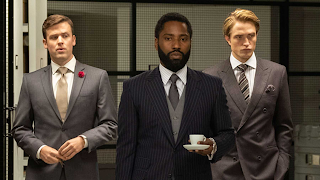
If Parasite is the better all round film, Tenet takes the win because it reaffirmed my love for filmmaking. This is an awe-inspiring, towering work of ambition from Christopher Nolan. The master of introducing concepts and tinkering and evolving them, here he takes that skill to a whole new level. When ideas are this head-spinning, you do not need rich three-dimensional characters to keep your interest. Luckily still the characters are memorable enough, but it is the technical bravura of the film that is astonishing: a 'how did they do that / who thought of that' film. With blistering action scenes scored by an almighty Ludwig Goransson accompaniment, Tenet reverberates for hours after. The temporal pincer strategy is one of the coolest, smartest things going. And the building explosion / restoration? Beyond awesome.  


Here's hoping No Time to Die, Dune, Top Gun: Maverick and Mission Impossible 7 make it to the big screen next year. 


Here are also the best films I saw for the first time this year outside of the cinematic release:
The Third Man, The Mission, Brief Encounter, Heaven's Gate, Dazed and Confused, Carlito's Way, McCabe & Mrs Miller, Das Boot, Tinker Tailor Soldier Spy, To Kill a Mockingbird, American History X, Keoma, Sleuth. 

Sunday, 22 November 2020

Sean Connery 1930-2020

 The lighting of a cigarette. The famous John Barry theme music. “Bond, James Bond”. The camera finally reveals Ian Fleming’s legendary spy to the world, in the face of the Scottish Sean Connery, who has passed away at the grand age of 90. In terms of cinematic introductions, it is one of the most iconic, kickstarting one of the longest running and most successful film franchises of all time. In terms of actors, he is one of the most distinct, winning and infallible presences in motion picture history.

Connery won the Bond role through pure charm, allegedly wearing scruffy clothes to his meeting with the producers yet displaying enough rugged masculinity to seal his place in the hall of fame. His performance as the globe-trotting British agent is one that has stuck to the core of my childhood. My first experience with Connery’s Bond was with Goldfinger (1964) wherein he emerged from the water in a tight black wetsuit, only to whip it off and reveal an immaculate white tuxedo underneath, adorned with a red flower. The same sequence closes with him throwing an electrical appliance at an opponent in the bath. “Shocking” he quips. As far as my seven-year-old brain went, it was the coolest thing I had ever seen.

Bond has been played six times in the mainstream franchise, but it is always, always Connery we compare to. He is the only the Bond actor to come back to the role after previously handing it off (twice, if you include the offbeat 1983 film Never Say Never Again) and is the only of the Bond actors to claim that he influenced Fleming’s writings: the author revealed that Bond’s father was in fact Scottish. It is easy to say that we will always compare to Connery because he was the first; the first to order the martini, the first to drive the Aston Martin and the first to remark “I think he got the point” after harpooning an assailant to a tree. But that is only part of the reason. Connery’s earthy charm, quick wit, just-about-threatening physicality and wry smile are quintessential components for the character.

The first five Bond films alone would be a great legacy, but Connery has left a remarkable body of work outside of his franchise, arguably the only Bond actor to do so. Keen to detach himself from that image, he took on a range of roles for a variety of directors: there is  Marnie, A Bridge Too Far, The Untouchables (for which he won his Oscar), cult classic Highlander, a scene stealing role in The Last Crusade, The Hunt for Red October and the ultimate Friday night with beers film, The Rock. Connery’s very presence in these elevates them to the top levels of big screen entertainment, deploying his thick accent with gusto. His line of work is filled with memorable, funny quotations, making it easy to forget the emotional guns he fired in The Last Crusade or The Untouchables.

If there is one film of special mention it is The Man Who Would Be King, in which Connery was paired with Michael Caine as two British soldiers who journey into 19th century Kafiristan, only for Connery’s character to become a doomed, god-like king. Connery’s favourite film to do, the picture sees his character (Daniel) wanting to do away with his past job in search of something greater. It more than draws comparisons to Connery’s own adventure away from the Bond franchise, but whilst Daniel fails, Connery succeeded- massively. The Man Who Would Be King? The Man Who Was a King.


Sunday, 15 November 2020

100 Greatest Films of All Time

 I have not seen every film. Nor would I have the assumption that I have the ability to define what is great, or what greatness is. When reading the lists of Sight & Sound, Roger Ebert or the AFI / BFI, it becomes clear that greatness in film is measured by general popularity combined with meticulous craftsmanship and how groundbreaking and influential a film is. This is a logical place to start: combing through audience lists like Empire Magazine or IMDb determines what the general public like, but then this omits films from cinema's early years that are lost in the mainstream. There is a third aspect I feel has to be measured when it comes to 'greatness': what the film art-form actually does. When I drew up around 200 'nominated' films for this list, what guided me was to what extent did each film's story serve the medium the most; if the film could be as well told in another artistic mediums, does that diminish its position? The films I ended up choosing are the ones that best exemplify what makes the filmmaking medium the most potent of the arts: when editing, photography and music form a symbiotic relationship. A further rule I set was that no director could be represented more than three times on this list in order to have some sense of diversity in filmmaking style. So whilst The Conversation, Ikiru and Great Expectations are all immensely worthy of the list, Coppola, Kurosawa and Lean all have three stronger entries to show their style. 

These are not my 100 favourite films, but these are 100 films that I deem vital to cinema's history and remind me what makes filmmaking so special, even if I don't overwhelmingly like some of them.  

*no order*

 Battleship Potemkin (Sergei Eisenstein, 1925)

Napoleon (Abel Gance, 1927)

City Lights (Charlie Chaplin, 1931)

M (Fritz Lang, 1931)

Scarface (Howard Hawks, 1932)

Duck Soup (Leo McCarey, 1933)

The Wizard of Oz (Victor Fleming, 1939)

The Grapes of Wrath (John Ford, 1940)

Double Indemnity (Billy Wilder, 1944)

A Matter of Life and Death (Michael Powell, Eric Pressburger, 1946)

The Red Shoes (Michael Powell, Eric Pressburger, 1948)

The Treasure of the Sierra Madre (John Huston, 1948)

The Searchers (John Ford, 1956)

Touch of Evil (Orson Welles, 1958)

The Hustler (Robert Rossen, 1961)

Harakiri (Masaka Kobayashi, 1962)

The Graduate (Mike Nichols, 1967)

The Wild Bunch (Sam Peckinpah, 1969)

The Man Who Shot Liberty Valance (John Ford, 1962)

McCabe & Mrs Miller (Robert Altman, 1971)

Alien (Ridley Scott, 1979)

Body Heat (Lawrence Kasdan, 1981)

Once Upon a Time in America (Sergio Leone, 1984)

Ran (Akira Kurosawa, 1985)

My Neighbour Totoro (Hayao Miyazaki, 1988)

JFK (Oliver Stone, 1991)

 Carlito's Way (Brian De Palma, 1993)

The Shawshank Redemption (Frank Darabont, 1994)


Children of Men (Alfonso Cuaron, 2006)

No Country for Old Men (Coen Brothers, 2007)

Whiplash (Damien Chazelle, 2014)

The Revenant (Alejandro Inarritu, 2015)

Blade Runner 2049 (Dennis Villeneuve, 2017)

Parasite (Bong Joon-ho, 2019)


70. Harakiri (Masaka Kobayashi, 1962)

69. Ran (Akira Kurosawa, 1985)

68. Downfall (Oliver Hirschbiegel, 2004)

67. L.A. Confidential (Curtis Hanson, 1997)

66. Inception (Christopher Nolan, 2010)

65. Taxi Driver (Martin Scorsese, 1976)

64. The Seventh Seal (Ingmar Bergman, 1957)

63. Schindler's List (Steven Spielberg, 1993)

62. Mr Smith Goes to Washington (Frank Capra, 1939)

61. North by Northwest (Alfred Hitchcock, 1959)

60. Wall-E (Andrew Stanton, 2008)

59. Before Sunrise (Richard Linklater, 1995)

58. Silence of the Lambs (Jonathon Demme, 1991)

57. The Lion King (Roger Allers, Rob Minkoff, 1994)

56. Rear Window (Alfred Hitchcock, 1954)

55. La La Land (Damien Chazelle, 2016)

54. The Dark Knight (Christopher Nolan, 2008)

53. All the President's Men (Alan J Pakula, 1976)

52. The Raid (Gareth Evans, 2011)

51. To Kill a Mockingbird (Robert Mulligan, 1962)

50. The Thin Red Line (Terence Malick, 1998)

49. Inside Out (Pete Doctor, 2015)

48. Back to the Future (Robert Zemeckis, 1985)

47. M (Fritz Lang, 1931)

46. Bicycle Thieves (Vittorio De Sica, 1948)

45. Se7en (David Fincher, 1995)

44. There Will Be Blood (Paul Thomas Anderson, 2007)

43. Tokyo Story (Yasujiro Ozu, 1953)

42. It's A Wonderful Life (Frank Capra, 1946)

41. Star Wars (George Lucas, 1977)

40. The Empire Strikes Back (Irvin Kershner, 1980)

39. In the Heat of the Night (Norman Jewison, 1967)

38. The French Connection (William Friedkin, 1971)

37. 12 Angry Men (Sydney Lumet, 1957)

36. Unforgiven (Clint Eastwood, 1992)

35. 12 Years a Slave (Steve McQueen, 2013)

34. Jaws (Steven Spielberg, 1975)

33. Mad Max: Fury Road (George Miller, 2015)

32. One Flew Over the Cuckoo's Nest (Milos Forman, 1975)

31. Dog Day Afternoon (Sydney Lumet, 1975)

30. Heat (Michael Mann, 1995)

29. Memento (Christopher Nolan, 2000)

28. The Deer Hunter (Michael Cimino, 1978)

27. Spirited Away (Hiyao Miyazaki, 2001)

26. Pan's Labyrinth (Guillermo Del Toro, 2006)

25. Raging Bull (Martin Scorsese, 1976)

24. Toy Story (John Lasseter, 1995)

23. Rashomon (Akira Kurosawa, 1950)

22. The Godfather Part II (Francis Ford Coppola. 1974)

21. The Bridge on the River Kwai (David Lean, 1957)

20. The Lord of the Rings (Peter Jackson, 2001-2003)

19. The Shining (Stanley Kubrick, 1980)

18. The Good, the Bad and the Ugly (Sergio Leone, 1966)

17. Brief Encounter (David Lean, 1945)

16. A Clockwork Orange (Staley Kubrick, 1971)

15. Battleship Potemkin (Sergei Eisenstein, 1925)

14. Singin' in the Rain (Stanley Donan, Gene Kelly, 1952)

13. The Exorcist (William Friedkin, 1973)

12. Chinatown (Roman Polanski, 1974)

11. Das Boot (Wolfgang Peterson, 1984)

10. Psycho (Alfred Hitchcock, 1960)

9. Casablanca (Michael Curtiz, 1943)

8. Citizen Kane (Orson Welles, 1941)

7. The Third Man (Carol Reed, 1949)

6. Apocalypse Now (Francis Ford Coppola, 1979)

5. Once Upon a Time in the West (Sergio Leone, 1968)

4. Seven Samurai (Akira Kurosawa, 1954)

3. The Godfather (Francis Ford Coppola, 1972)

2. Lawrence of Arabia (David Lean, 1962)

1. 2001: A Space Odyssey (Stanley Kubrick, 1968)


Thursday, 3 September 2020

Film Quotations of the 2010s

 I recently read the American Film Institute's '100 Years... 100 Quotes' list and found myself struggling to think of lines of dialogue from the 2010s that were as iconic and memorable as "Gentlemen, you can't fight in here! This is the War Room!" or "Go ahead. Make my day". After trawling through the last decade, I realised there are some iconic belters. Here are my 40 picks for the most quoted, memorable and best lines of the 2010s. 

40. "I fucked up my whole life because of the way you sing" - Ethan Hawke, Before Midnight 

39. "A man becomes a critic when he cannot be an artist, the same way a man becomes an informer when he cannot be a soldier" - Michael Keaton, Birdman  

38. "Manners maketh man" - Colin Firth, Kingsman: The Secret Service

37. "Let them fight" - Ken Watanabe, Godzilla 

36. "Hi Georgie!" - Bill Skarsgaard, IT 

35. "Is that a monkey?" - Toby Kebbell, Kong: Skull Island 

34. "I am fire... I am death" - Benedict Cumberbatch, The Hobbit: The Desolation of Smaug

33. "I'm kinda thinking it's the other way around. You know, like the moment seizes us" - Jesse Mechler, Boyhood 

32. "Nah it was dumber than that" - Brad Pitt, Once Upon a Time in... Hollywood

31. "I ain't afraid to die anymore. I done it already" - Leonardo DiCaprio, The Revenant 

30. "Mightn't happen to have a piece of cheese about you, now?" - Harrison Ford, Blade Runner 2049

29. "A man without balls is a Munich" - Ryan Gosling, The Nice Guys 

28. "Just one more" - Andrew Garfield, Hacksaw Ridge 

27. "Which would be worse, to live as a monster or die as a good man?" - Leonardo DiCaprio, Shutter Island

26. "Docking" - Matthew McConaughey, Interstellar 

25. "What do I have in my pocket?" - Martin Freeman, The Hobbit: An Unexpected Journey 

24. "Not everything. Not yet" - Christian Bale, The Dark Knight Rises

23. "The show goes on!" - Leonardo DiCaprio, The Wolf of Wall Street

22. "Apes together strong" - Andy Serkis, War for the Planet of the Apes  

21. "My name is... Jeff" - Channing Tatum, 22 Jump Street

20. "Oh fuck off you big lamp" - Simon Pegg, The World's End

19. "Wakanda Forever" - Chadwick Boseman, Black Panther 

18. "Never be afraid to dream a little bigger, darling" - Tom Hardy, Inception

17. "He's a friend from work" - Chris Hemsworth, Thor Ragnarok

16. "Get the sheriff and then the Marshall" - Christoph Waltz, Django Unchained 

15. "People love what other people are passionate about" - Emma Stone, La La Land

14. "A doughnut hole in the doughnut's hole" - Daniel Craig, Knives Out

13. "We are what they grow beyond" - Frank Oz, Star Wars: The Last Jedi

12. "Time takes everyone out; time's undefeated" - Sylvester Stallone, Creed 

11. "Chewie, we're home" - Harrison Ford, Star Wars: The Force Awakens

10. "So this is what it feels like" - Hugh Jackman, Logan

9. "You should have gone for the head" - Josh Brolin, Avengers: Infinity War

8. "Always" - Alan Rickman, Harry Potter and the Deathly Hallows Part 2

7. "Look at me- I am the captain now" - Barkhad Abi, Captain Phillips

6. "You're awful Murray" - Joaquin Phoenix, Joker

5. "Get me a Hammerhead Corvette. I have an idea" - Paul Kasey, Rogue One: A Star Wars Story

4. "Avengers Assemble" - Chris Evans, Avengers: Endgame

3. "Not quite my tempo" - J.K Simmons, Whiplash

2. "No!" - Andy Serkis, Rise of the Planet of the Apes

1. "What a day! What a lovely day!" - Nicholas Hoult, Mad Max: Fury Road